

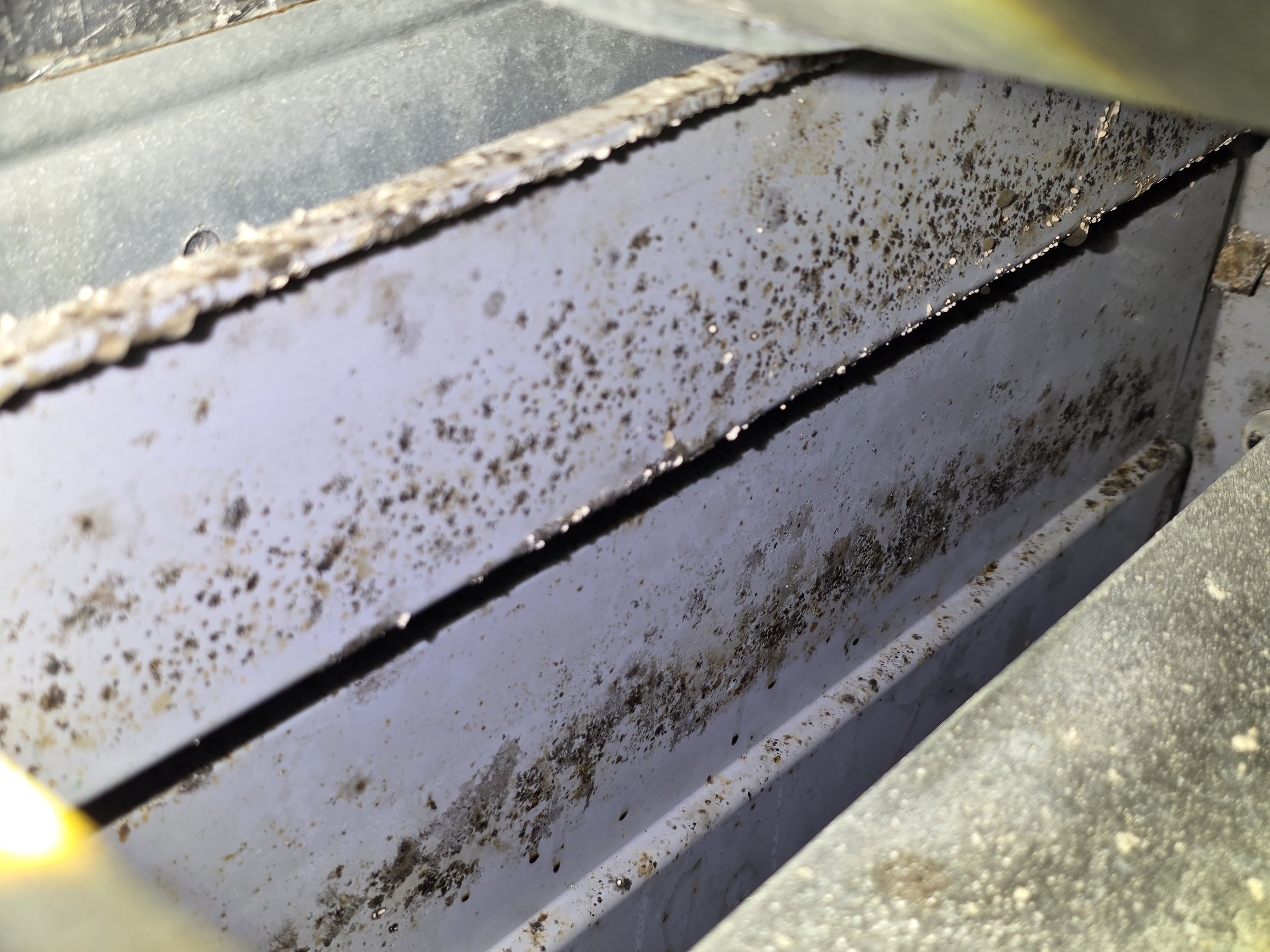
Mold air sampling is one of the most commonly requested services during a mold assessment.
Homeowners often ask questions such as:
“Can you test the air to see if I have mold?”
“What is a safe mold level?”
“Can an air test tell me where the mold is coming from?”
“Do I need mold testing if I can already see mold?”
“Can air sampling tell me whether the house is safe?”
The answer is more complicated than simply collecting an air sample and looking at a number on a laboratory report.
Air sampling can provide useful information under the right circumstances, but it should be part of a broader mold assessment—not a substitute for one.
A professional mold assessment should consider the building history, visible conditions, moisture sources, indoor humidity, HVAC system, areas of previous water damage, and other conditions before deciding whether air sampling is appropriate.
What Is Mold Air Sampling?
Mold air sampling involves drawing a measured amount of air through a sampling device designed to capture airborne fungal spores and other particles.
The sample is then sent to a laboratory for microscopic analysis.
The laboratory report may provide information about:
Types or groups of fungal spores identified
Estimated concentrations of airborne spores
Relative differences between sampling locations
Differences between indoor and outdoor samples
Air sampling provides information about what was airborne at the specific time and location the sample was collected.
That distinction is important.
Airborne mold concentrations can change because of:
Outdoor conditions
Weather
Wind
Indoor activity
HVAC operation
Doors or windows being opened
Cleaning
Construction activity
Movement of occupants
Seasonal conditions
Changes in moisture conditions
For that reason, a mold air sample should not be viewed as a permanent measurement of the building.
There Is No Universal “Safe Mold Number”
One of the biggest misconceptions about mold testing is that there is a specific number that determines whether a home passes or fails.
There is not.
The EPA has not established federal limits for airborne mold or mold spores, and CDC/NIOSH notes that there are no health-based standards for mold concentrations in indoor air.
That means a laboratory result should not be interpreted simply as:
Below this number = safe
or
Above this number = unsafe
Mold results require professional interpretation.
The types of spores present, relative concentrations, indoor versus outdoor conditions, moisture history, visible fungal growth, HVAC conditions, and sampling locations all matter.
When Mold Air Sampling Can Be Useful
Air sampling can be valuable when it is used to answer a specific question about the building.
Here are several situations where air sampling may provide useful information.
1. When Mold Is Suspected but No Obvious Source Is Visible
One of the more useful applications for air sampling is when there are indicators of a possible mold problem but visible fungal growth has not been located.
Examples may include:
Persistent musty odors
Previous water intrusion
Known roof leakage
Plumbing leaks
HVAC condensation
Elevated indoor humidity
Previous flooding
Water-damaged building materials
Suspected contamination in an inaccessible area
In these situations, targeted air sampling may provide additional information that helps determine whether further investigation is warranted.
However, air sampling alone usually cannot tell the assessor exactly where a concealed mold source is located.
The goal should still be to identify the underlying moisture problem and possible source of fungal amplification.
2. When Different Areas of the Home Need to Be Compared
Air samples may also be useful when one part of a building appears more suspect than another.
For example, a homeowner may report:
A musty odor in one bedroom
Previous water damage in one area
HVAC-related moisture near certain rooms
A roof leak affecting one portion of the home
A history of plumbing leakage in a bathroom
Condensation around specific supply registers
Samples collected in strategically selected areas may help determine whether there are meaningful differences between portions of the building.
Sampling locations should be chosen based on the building investigation—not randomly scattered throughout the house simply to increase the number of samples.
3. When Indoor Air Needs to Be Compared With Outdoor Conditions
Outdoor air naturally contains mold spores.
Mold is part of the natural environment, so finding fungal spores in an indoor air sample does not automatically mean there is an indoor mold problem.
This is why outdoor control or background samples can be important.
Indoor samples can be compared with outdoor conditions to help evaluate whether the indoor environment shows an unusual fungal profile or concentration.
IAC2 sampling guidance recommends collecting indoor and outdoor air samples for comparison and recognizes that airborne mold concentrations can vary significantly with environmental and atmospheric conditions.
The comparison is more useful than looking at an indoor spore count by itself.
4. When the Source of Mold Contamination Is Unclear
Sometimes visible mold exists, but the overall extent or source of contamination remains uncertain.
For example:
Visible growth may be present around an HVAC supply register, but additional investigation may be needed to determine whether the condition is localized or associated with a broader HVAC or moisture problem.
Or a room may contain previous water damage and musty odors even though the visible fungal growth appears limited.
Targeted sampling may provide another piece of information when determining the extent of the problem.
The EPA specifically notes that sampling may be considered when the source of mold contamination is unclear.
5. When Evaluating HVAC-Related Mold Concerns
HVAC systems can play an important role in indoor moisture conditions.
Potential concerns may include:
Condensation at supply registers
Moisture inside air-handler cabinets
Contaminated insulation
Growth on HVAC components
High indoor humidity
Damaged or poorly insulated ductwork
Air leakage
Condensate drainage problems
When HVAC-related contamination is suspected, air sampling may be one component of the assessment.
However, laboratory results should be considered together with:
Visual observations
Moisture measurements
Humidity readings
HVAC operating conditions
Surface sampling when appropriate
Condition of the air handler and accessible duct components
An air sample alone does not determine the condition of an entire HVAC system.
6. When Documenting Conditions During a Real Estate Transaction
Mold concerns sometimes arise during the purchase or sale of a home.
A buyer may encounter:
Visible suspected mold
Musty odors
Previous water damage
Seller-disclosed leaks
Elevated moisture
HVAC contamination
Previous mold remediation
In these situations, air sampling may provide additional objective information when incorporated into a professional mold assessment.
The results may help the buyer better understand current conditions and determine whether additional investigation or remediation is appropriate.
The laboratory report should still never be considered in isolation.
7. When Establishing a Baseline Before Remediation
In some mold assessments, air sampling may help document conditions before remediation begins.
This can be useful when the assessor needs to evaluate:
Areas of suspected contamination
Relative indoor fungal conditions
Potential HVAC involvement
The extent of affected areas
Differences between rooms or building zones
The information can then be considered along with visible conditions and moisture findings when developing a remediation protocol.
Not every remediation project requires extensive air sampling.
The sampling strategy should be based on the conditions of the individual property.
8. During Post-Remediation Verification When Appropriate
After professional mold remediation, the affected areas should be evaluated before containment is removed and the project is considered complete.
Post-remediation verification may include:
Visual inspection
Verification that visible fungal growth has been removed
Evaluation of remaining building materials
Moisture measurements
Confirmation that the moisture source has been corrected
Evaluation of cleanliness
Air or surface sampling when appropriate
Sampling requirements can vary depending on the remediation protocol and project conditions.
Air sampling should not replace the physical evaluation of the remediated areas.
A clean-looking laboratory report does not make remaining visible fungal contamination acceptable.
Likewise, successful remediation requires more than simply reducing an airborne spore count.
When Air Sampling May NOT Be Necessary
There are many situations where collecting air samples adds little useful information.
Visible Mold Is Already Present
If visible fungal growth is clearly present and the moisture source has been identified, air sampling may not change the recommended course of action.
EPA guidance states that in most cases, when visible mold growth is present, sampling is unnecessary.
The priority becomes:
Identify the moisture source → correct the moisture problem → properly remediate the affected materials.
Testing visible mold simply to prove that mold exists may provide little additional value.
A Known Water-Damaged Material Clearly Needs Removal
Imagine drywall has been repeatedly wetted by a plumbing leak and visible fungal growth is present.
Whether an air sample reports 300 spores per cubic meter or 3,000 spores per cubic meter does not change the fact that the moisture source must be corrected and the affected material properly addressed.
Sampling should ideally answer a meaningful question.
If the result will not change the assessment or recommendations, the value of collecting the sample may be limited.
Routine “Whole-House Mold Testing” Without an Investigation
Collecting several air samples without first inspecting the building is not the same thing as performing a professional mold assessment.
A proper assessment begins with the building.
The assessor should evaluate:
Why the client is concerned
Water-intrusion history
Plumbing history
Roof history
HVAC operation
Indoor humidity
Visible fungal growth
Moisture conditions
Musty odors
Building materials
Areas of previous remediation
Only after understanding those conditions should a sampling strategy be developed.
Why an Outdoor Control Sample Matters
Outdoor mold spores naturally enter homes through:
Doors
Windows
Ventilation
HVAC systems
Air leakage
Normal occupant activity
Because of this, finding mold spores indoors is expected.
The question is whether the indoor fungal profile appears consistent with normal outdoor influence or whether the findings suggest an indoor amplification source.
Outdoor samples provide a background reference for interpreting indoor samples.
Ideally, indoor and outdoor samples are collected under reasonably comparable conditions and close enough in time that the outdoor environment has not changed dramatically.
Severe weather, high winds, rain, nearby construction, lawn maintenance, and other environmental conditions can influence outdoor airborne mold concentrations and therefore affect interpretation.
Why the Highest Spore Count Is Not Always the Most Important Finding
Homeowners often focus immediately on the largest number on the laboratory report.
But the total spore count does not tell the entire story.
An assessor may also consider:
Which fungal types were identified
Whether those types were present outdoors
Indoor-to-outdoor relationships
Whether one indoor area differs substantially from another
Whether certain fungal types are associated with water-damaged building materials
Visible growth
Moisture measurements
Indoor humidity
HVAC conditions
Building history
A lower total count with an unusual indoor fungal profile may sometimes deserve more attention than a higher count dominated by common outdoor spores.
This is why laboratory interpretation should always be performed in the context of the building assessment.
Mold Air Sampling Is a Snapshot
Another important limitation is that air sampling captures conditions during a relatively short sampling period.
Airborne fungal concentrations can change.
A sample collected today may not look identical to a sample collected:
Tomorrow
After a rainstorm
During high winds
With the HVAC operating differently
After doors and windows have been opened
After cleaning
During construction activity
CDC/NIOSH specifically notes that short-term mold air samples may not represent actual long-term exposures and that airborne concentrations can be highly variable.
For this reason, one air sample should never be treated as a complete description of everything occurring inside a building.
Can Mold Air Sampling Determine Whether a House Is “Safe”?
Not by itself.
There is no single federally established airborne mold concentration that separates a “safe” home from an “unsafe” home.
The laboratory report also cannot determine whether a particular occupant will experience health effects.
People respond differently to environmental exposures, and medical concerns should be discussed with an appropriate healthcare provider.
A mold assessor's role is to evaluate the building and identify conditions associated with moisture and fungal growth.
What Should a Professional Mold Assessment Include?
When mold is a concern, the most valuable information usually comes from combining multiple pieces of evidence.
A professional assessment may include:
Building History
Understanding previous:
Roof leaks
Plumbing leaks
Flooding
HVAC problems
Water intrusion
Remediation
Renovations
can help identify where problems may have originated.
Visual Inspection
The assessor evaluates readily accessible areas for:
Suspected fungal growth
Water staining
Damaged materials
Condensation
HVAC contamination
Signs of previous leakage
Moisture Testing
Moisture meters can help determine whether building materials are currently elevated in moisture.
Indoor Humidity Measurements
High indoor humidity can contribute to condensation and conditions favorable for fungal growth.
Infrared Thermal Imaging
Thermal imaging may help locate temperature anomalies that warrant further investigation.
Thermal imaging does not directly detect mold or moisture.
Air Sampling
Air samples may be collected when they can help answer a specific question about indoor conditions.
Surface Sampling
Swab or tape samples may be useful when visible material needs laboratory identification or when specific surface conditions need to be documented.
Mold Testing vs. Mold Assessment
There is an important difference between simply collecting mold samples and performing a mold assessment.
Mold testing is the act of collecting samples.
A mold assessment involves evaluating the building, investigating moisture conditions, considering the history of the property, interpreting laboratory results when sampling is performed, and developing conclusions about the likely source and extent of fungal contamination.
In Florida, mold assessment is a regulated professional service. Florida DBPR describes mold assessment as including physical sampling and detailed evaluation of building-history and inspection data used to develop an assessment of the origin, identity, location, and extent of mold amplification.
The laboratory data is only one part of that process.
The Most Important Question Before Taking an Air Sample
Before collecting a mold air sample, the assessor should be able to answer:
“What question are we trying to answer with this sample?”
If there is no clear reason for collecting it, the result may provide little useful information.
Good mold sampling should be targeted.
Examples of useful questions might include:
Is there evidence suggesting an indoor fungal amplification source?
Does one area differ significantly from other parts of the home?
Are indoor fungal conditions unusual compared with outdoors?
Is a suspected moisture-damaged area affecting the indoor environment?
Is additional investigation warranted?
Is sampling appropriate as part of post-remediation verification?
Sampling should support the investigation—not replace it.
Mold Air Sampling in Northwest Florida
Northwest Florida presents unique moisture-management challenges.
Homes throughout Pensacola, Navarre, Gulf Breeze, Pace, Milton, Cantonment, Crestview, Niceville, Fort Walton Beach, Destin, Miramar Beach, and surrounding communities may experience:
High outdoor humidity
Heavy rainfall
Tropical weather
Roof leaks
Wind-driven rain
HVAC condensation
Long air-conditioning seasons
Indoor humidity problems
Plumbing leaks
Coastal moisture exposure
These conditions make identifying and correcting moisture sources especially important when mold is suspected.
Professional Mold Assessments by J. Gregory Home Inspections
J. Gregory Home Inspections provides professional mold assessments throughout Northwest Florida.
Assessments are performed by Josh Gregory, Florida Licensed Mold Assessor MRSA5499.
Depending on the property and conditions, a mold assessment may include:
Building-history review
Visual evaluation
Moisture testing
Indoor humidity measurements
Infrared thermal imaging
HVAC evaluation
Air sampling when appropriate
Surface sampling when appropriate
Laboratory analysis
Investigation of potential moisture sources
Mold remediation protocols
Post-remediation verification
We provide mold assessment services independently and do not perform mold remediation.
Frequently Asked Questions About Mold Air Sampling
Do I need air sampling if I can already see mold?
Not always.
If visible fungal growth is present and the moisture source is known, sampling may not change the recommended corrective action.
The visible contamination and moisture source still need to be properly addressed.
Does mold air sampling tell me exactly where mold is located?
Usually not.
Air sampling can indicate that airborne fungal conditions deserve additional investigation, but it does not provide an exact map of where concealed fungal growth is located.
The building assessment is necessary to investigate potential sources.
Is any mold in an air sample bad?
No.
Mold spores naturally exist outdoors and can enter buildings during normal everyday activities.
The presence of some fungal spores indoors is expected.
Interpretation focuses on the overall pattern, types of spores present, concentrations, indoor/outdoor relationships, and building conditions.
Is there a passing mold level?
There is no universal EPA or federal pass/fail concentration for airborne mold in residential buildings.
Laboratory findings must be interpreted with the conditions observed during the assessment.
Why do you collect an outdoor sample?
The outdoor sample provides background information that can help interpret indoor samples.
Indoor air should not be evaluated in isolation from outdoor environmental conditions.
Can an air sample prove a house has no mold?
No.
A normal air sample cannot guarantee that no concealed fungal growth exists somewhere in a building.
Air sampling represents conditions at the sampling location during a limited period of time.
Should every room be sampled?
Not necessarily.
Sampling locations should be based on the purpose of the assessment and specific areas of concern.
More samples do not automatically produce a better assessment.
Can air sampling diagnose health problems?
No.
Environmental mold sampling does not diagnose medical conditions or determine how a particular person will respond to exposure.
Medical concerns should be discussed with a qualified healthcare provider.
Schedule a Mold Assessment in Northwest Florida
If you're dealing with musty odors, previous water damage, visible suspected mold, HVAC contamination, elevated indoor humidity, or unexplained moisture, simply collecting random mold samples may not provide the answers you need.
The first step should be determining why the problem may be occurring and where the moisture is coming from.
J. Gregory Home Inspections provides professional mold assessments and mold sampling throughout Northwest Florida, including Pensacola, Navarre, Gulf Breeze, Pace, Milton, Cantonment, Fort Walton Beach, Destin, Crestview, Niceville, Miramar Beach, and surrounding communities.
J. Gregory Home Inspections
Josh Gregory
Florida Licensed Mold Assessor — MRSA5499
Florida Licensed Home Inspector — HI10393
Call or Text: 850-904-6955